guide
Introducing Interoperability Agent

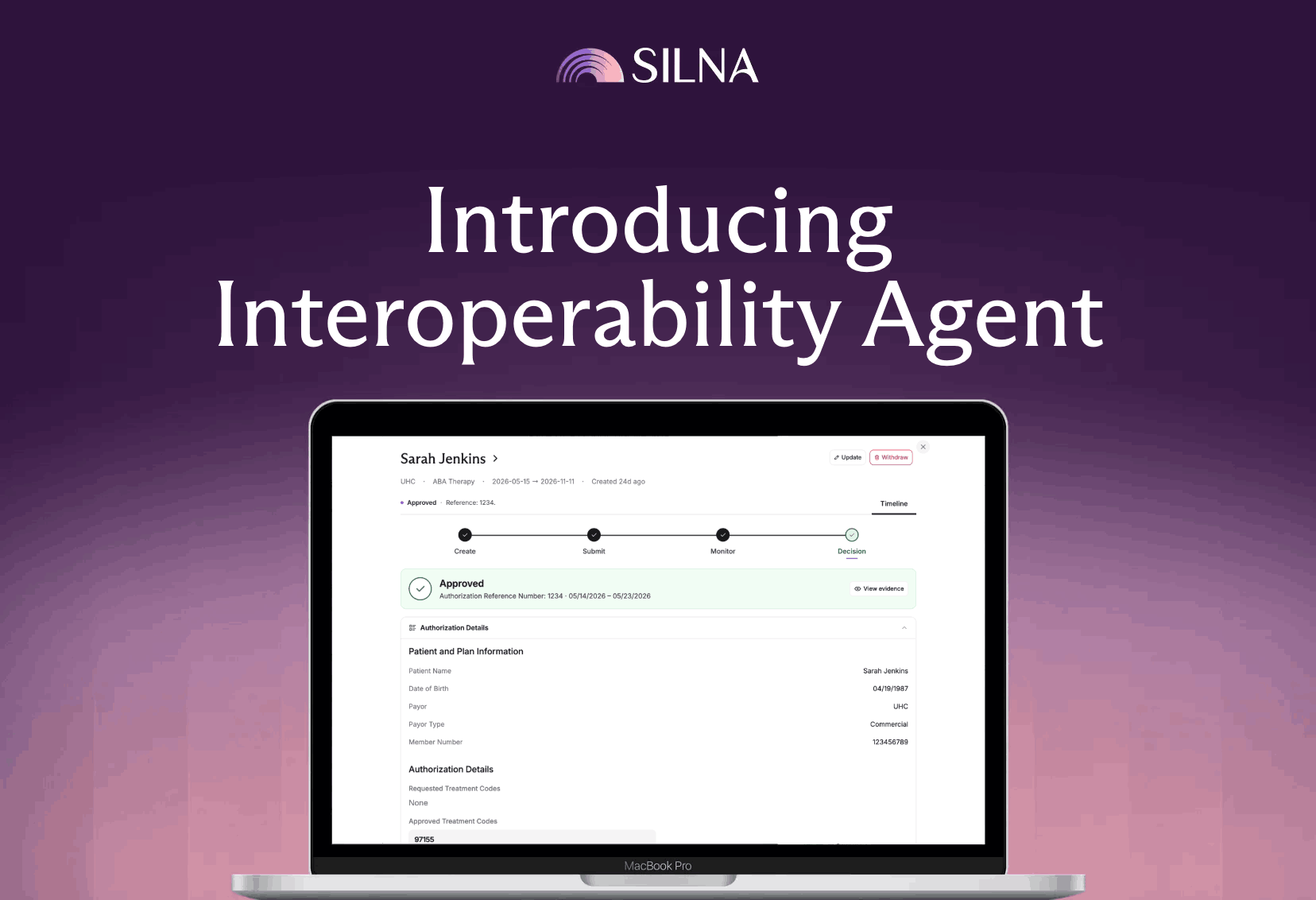
Silna now connects directly to any EHR, practice management system, or intake system with no formal integration necessarily required. Many providers connect to Silna through our public API, and for teams with engineering resources, that remains the cleanest path. The Interoperability Agent is for everyone else – connecting directly to the systems your team already works in, no engineering required.
The problem: data that doesn’t move itself
Most provider teams using Silna work across at least two systems – handling authorizations and benefit verifications. Their EHR or practice management system holds the patient record. When a task completes in Silna, someone on the team manually moves the data by either entering results, updating records, or pulling reports.
For teams running dozens or hundreds of authorizations and benefit checks, it means staff time spent on work that shouldn’t need human attention.
Getting data into Silna requires the same effort in reverse by pulling patient and payer information out of an intake system or EHR before a request can even start.
Silna’s public API handles this automatically for providers with in-house engineering, and many already use it that way. But most provider organizations don’t have a developer available to build or maintain an API connection. For them, the gap between what Silna can automate and what actually gets done has stayed open.
What Interoperability Agent does
Using the same agent technology that powers Silna’s browser-based payor portal submissions, Interoperability Agent uses AI agents to interact with provider systems the same way a trained employee would by navigating screens, pulling patient and insurance data, and updating records according to your team’s existing workflow.
The result is that Silna can work with any system your team already uses, regardless of whether that system has a public API or a formal integration with Silna.
Anything a human would do in the EHR, an agent can mimic.
Here’s how it works:
- Pulling data in (first mile): When a new authorization or benefit check needs to be created, Interoperability Agent pulls the relevant patient and payor information from your system, whether it is tasks assigned in your EHR or reports. Staff don’t have to enter it manually.
- Pushing data back out (last mile): When a task completes in Silna, Interoperability Agent updates your system of record and follows your team’s own process for how that update should look.
What you don’t need:
- A formal EHR partnership or marketplace listing
- An API on your system’s side
- Technical work from your team to get started
How setup works
Getting started requires one thing from your team: your existing SOP.
Share a screen recording (or screenshots) of how your staff currently updates your EHR when a benefit check or authorization completes. Silna’s AI Ops team uses that to configure the integration, tests it on a sample patient, and activates it for your account. If your SOP changes, Silna updates the configuration to match.
Interoperability Agent is included in the Silna platform at no additional cost.
What happens when a sync fails
In the rare case a sync doesn’t complete, your team gets notified and can manually sync the data as a fallback.
Why it matters
Healthcare providers shouldn’t need a developer to connect two systems they already pay for. Interoperability Agent works with whatever your team already has, without any changes to how you work or a project for IT.
For teams that have been manually moving data between Silna and their EHR or other internal systems, this is the step that makes the workflow fully hands-off.
Interested in the Interoperability Agent? Get in touch and we’ll walk through the setup with your team.